
Partners
If you are one of the following types of partners, you can use the server authorization.
- Financial Advisor Platforms
- Self-operated quantitative platforms
Introduction
For API calls that do not require user participation, the App can use this flow to retrieve Access Tokens.
This flow is typically used for server-to-server interaction, as described in Section 4.4 of RFC6749.
With the received Access Token, the App can access its own resources on resource servers on behalf of itself, or access resources that the user has authorized the App to access directly without an authorization prompt, per a prior agreement.
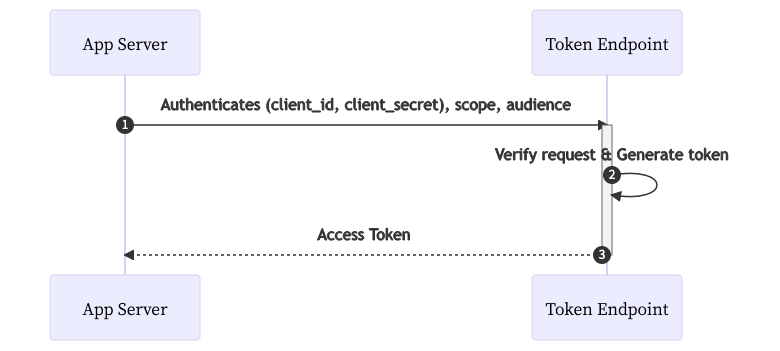
- This authorization method has only one step. The App Server directly requests an Access Token at the Token Endpoint.
- In the request, the App must set
grant_typeparameter toclient_credentials, and pass requested scopes viascopeparameter. - The App also needs to authenticate itself by one of the methods explained in Section Authentication Method.
- In the request, the App must set
- If the request is valid — i.e., the Authorization Server confirms the App's credentials are legitimate and the App is allowed to use the requested scopes — the Authorization Server will generate a JWT Access Token.
- The Access Token will then be returned to the App.
- The
subpayload claim of the token will be set toclient:{client_id}. - The response will also include
expires_in,scope, andtoken_type, as explained in the Token Endpoint API document.
- The
Please note that, in the Client Credentials Flow, the Authorization Server WILL NOT issue any
refresh_token.